How to choose a wool blanket?

It’s worth taking a little time to choose a woollen blanket, as it could be with you for a lifetime. In this article, we’ll introduce Balkanova’s blankets and help you find your way around their wide range.

Large or small?
If we start by categorising them by size, the majority of our blankets come in the classic ‘blanket’ size, which we define as 150×200 cm or similar dimensions. This is arguably the most versatile size with a wide range of uses – it can be used as a throw over a sofa or couch, a blanket to wrap yourself in whilst reading with a cup of tea in the early evening, or a blanket over your legs in a rocking chair; and if you put a duvet cover on it, you can use it as a cosy blanket for sleeping. So, if you need the most versatile blanket possible, we recommend choosing one measuring 150×200 cm. You’ll find 150×200 cm blankets in the Rodopa, Karandila, Kostadina, Gergana, Abata, Kaliakra, Marina, Perelika, Galata, Nara and Elma. In the latter two ranges, you’ll also find throws measuring 130×170 cm. These can therefore be used as versatile, easily portable throws.
If you’re choosing a blanket for your little one, whether a newborn or an older child, look for sizes 100×150 cm, 80×100 cm and 60×120 cm. The 100×150 size is compatible with standard children’s bed linen. You can safely use an unlined blanket to cover your child in a pram or as a travel blanket, not only for your child but also for an adult. For example, when travelling by bus, train or similar, such a blanket will serve you very well, as it is always to hand and doesn’t take up much space in your luggage. These are the Perelika or Gergana children’s blankets.
-

The Karandila blanket, measuring 150x200 cm, used as a
bedspread -

A classic among our blankets – the Perelika Belmondovka -

Very soft white
We also stock some blankets in the newborn size of 80x100 cm, which is a classic blanket for a pram or for tucking up the newest and smallest member of the family. And then there’s the specific size of 60×120 cm. This is a blanket that you can use as a mattress protector for a cot. Unlike rubberised or plastic mattress protectors, the blanket is breathable. Furthermore, wool has natural water-repellent properties and can usually protect the mattress in the event of minor accidents and against soiling. You can further enhance its water-repellency by using a suitable lanolin-based treatment for woollen products. Its size matches the most commonly used cot mattress size.
We have had all our undyed merino blankets, regardless of size, tested by a certified textile fibre laboratory, which confirmed that they meet the strict requirements for the ‘children’s’ label – i.e. they are certified for use by children from newborns up to the age of three. We had the undyed merino from which we produce our children’s sizes certified. All products made from this certified undyed merino wool are marked with a child’s head symbol and the description ‘Certified for children up to three years of age’, which you will find on the product page beneath each blanket made from certified merino wool.
In larger sizes, we offer some blankets from the Rodopa range and, in particular, the Karandila range. These come in sizes 200x220 cm and 210x230 cm, which is a throw for a double bed, if you like, or a double bed. Blankets in this size are characterised by a higher weight, which helps them retain their shape well on the bed during the day. At night, you can either set the blanket aside or, during the winter months, use it together with a duvet cover as a second layer of cover. Our plain or subtle multicoloured designs are sure to complement the aesthetic of your sanctuary of peaceful sleep.
Indoors or outdoors?
The 160x220 cm size and its variants are typical of the Rainbow range of blankets, which, amongst other things, have a very interesting history. However, it is important to note that the Rainbow is a classic blanket designed for outdoor use. Due to its high weight, it is a very warm blanket, suitable for tenting, camping or as an alternative to a sleeping bag all year round. The blanket is very robust, has a long lifespan, is durable and, thanks to its ‘felted’ finish, organic dirt is less likely to stick to it or accumulate whilst out in nature. Blankets in this range are characterised by combinations of bright colours and stripes, meaning they can also be used as a striking feature in your home – for example, as a throw over a sofa or bed. It’s worth noting that we also stock Rainbow blankets in sizes 160x240 cm and even 160x260 cm or 160x270 cm, so even the tallest of people will find something to suit them. Both sizes can be put to good use as an interesting curtain or an insulating screen. Wool, as is well known, is one of the best insulators, and the Rainbow, with its characteristic density, works well as a screen or a vestibule at the entrance to a building – which is, in fact, how we use it in our shop.


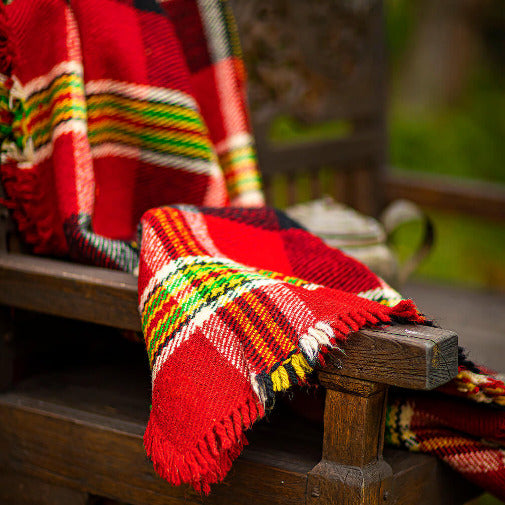
The Rodopa and Perelika checked blankets are certainly among those that are well suited to outdoor activities. For centuries, they have proven their worth through their long lifespan and quality, which truly lasts for generations. Thanks to their high weight, the Rodopa range, together with the Rainbow, are the warmest blankets in our range and are therefore suitable for outdoor use throughout the year. And just as an aside – the Rodopa range of blankets is a classic that ranks among the symbols of every mountain cottage in Bulgaria. The Rodopa will serve you well outdoors all year round, whilst its sister, the Perelika, due to its lower weight, is more suited to the spring and autumn seasons, for example as a throw for chilly evenings on the terrace. Its colourful design makes it an eye-catching addition to the living room, as a throw over the sofa, and so on. Other blankets, particularly those made from merino wool, are more suitable for indoor use due to the delicate nature of the fibre. Similarly, Karandila blankets, given their brushed surface, are better suited to indoor use.
-

The Perelika blanket is versatile – it’s suitable for both outdoors and indoors – for example, at a holiday cottage -

Rounding off the quartet is the Rainbow blanket, which can withstand even extreme conditions -

The Rodopa blanket is very robust and warm; it is suitable for both outdoor use and cold indoor environments – it is a classic mountain blanket with a long tradition
With or without fringes?
The Perelika, Elma and Galata blankets are adorned with hand-woven and knotted longer fringes. The same applies to the merino wool blankets Marina, Kostadina, Ledenika and Kaliakra. All feature beautiful, hand-tied decorative fringes approximately 10 cm long. The Karandila and Rodopa blankets do too, though their fringes are shorter and not braided. In contrast, the ‘Rainbow’ and ‘Gergana’ blankets have edges hemmed with thick thread – they feature what is known as ‘entlování’. This is particularly useful if you wish to put the blanket in a duvet cover and use it as a duvet. A blanket without fringes, such as the Gergana, or with very short fringes, such as the Rodopa, fits much better inside a duvet cover and retains its shape better. If you’re choosing a blanket for sleeping, to use inside a duvet cover, we recommend, for practical reasons, opting for one without fringes; fringes, on the other hand, emphasise the blanket’s distinctive appearance and its decorative role in the home.


Soft or rustic? And what does that actually mean?
The fineness of wool can be assessed in several ways. Whether a blanket feels soft to the touch or not is, to a large extent, a subjective sensation. What feels pleasant to one person may be a nuisance to another. And the same applies to wool. To make it easier for you to choose, the softness of each blanket is marked with one of five levels on a five-point scale, ranging from coarser to the softest: rustic – classic – soft – very soft – extra soft.
If you are someone who prefers soft materials but would still like a woollen blanket, we recommend focusing on blankets labelled either ‘very soft’ or ‘extra soft’. Our merino blankets fall into the ‘very fine’ category. These are truly very soft blankets, and in terms of softness, they are the most comparable to cotton out of all our blankets. All Perelika Merino, Kostadina, Marina, Kaliakra, Ledenika, Gergana and Rodopa Merino blankets are truly soft and are suitable even for children. The Gergana blanket, in particular, is even slightly softer than our other merino blankets, thanks to the merino wool used and its felted surface. From personal experience, we have found our merino blankets to be suitable for children from birth. As children grow and their needs – and ours – change, we are also expanding our range. For example, at the express request of our customers – mums – the Gergana blanket in the size 60×120 cm (used as a mattress protector) has been added to our range.
In the ‘extra-soft’ category, you’ll find the Perelika Merino and Marina ranges, which are even softer than our classic merino blankets. How is this possible? Merino blankets in the ‘very soft’ category are made from merino yarn with a fibre thickness of 25 microns. Merino blankets in the ‘extra soft’ category are made from merino with a fibre thickness of just 19–21 microns. There is a direct correlation between fibre thickness and the softness of the resulting material. The finer the fibre, the softer the blanket. In practical terms, the difference is similar to that between cotton and silk. So, in terms of softness, these really are top of the range!
-

The Kostadina blanket is made from merino wool and is therefore one of the softest in our range -

The Marina merino blankets are also among the softest -

The Ledenika merino throw is also very soft
The other three grades refer to blankets made primarily from local Bulgarian or Turkish wool, which is characterised by a slightly thicker fibre (fibre thickness in wool is measured in microns). The thicker the fibre, the less fine the wool. Finally, the finish of the blanket also plays a role, as it can soften the feel of the blanket to a level that is only slightly less soft than that of merino blankets. This is the case with our Karandila interior blankets, which have a brushed surface that feels very soft to the touch (classified as ‘soft’ in our range).
Generally speaking, blankets made from fine materials or with a finer surface are slightly more delicate. Blankets that can be described as more ‘durable’ – capable of withstanding even extreme conditions and outdoor use – are, logically, also slightly coarser (labelled as ‘classic’ and ‘rustic’ in our range), but even these will soften with time and use. This process can be accelerated by washing the blanket in accordance with our care instructions. Even with blankets of this specified texture (rustic, classic), it is therefore possible to achieve a certain softening of the surface over time, without the blanket losing its density and robustness.
Natural or dyed?
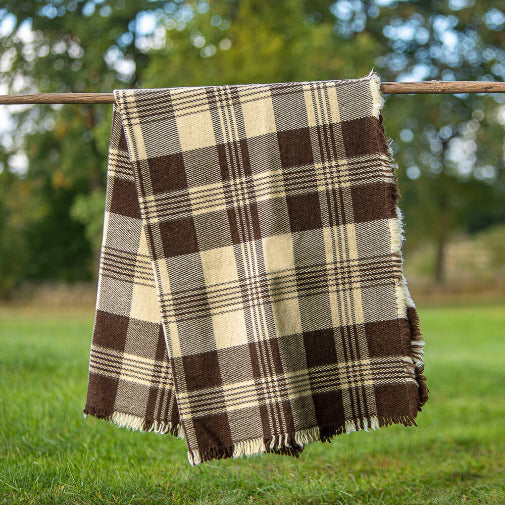
Essentially, all blankets in shades of white, cream, ivory or amber, as well as those in various shades of brown and grey, are made from undyed wool. If you’re a fan of the original, natural look, then these blankets are the right choice for you. For those made exclusively from undyed wool (Rodopa, Karandila, Abata, Perelika, Elma etc.), you’ll find the symbol ‘Made from natural undyed wool’ beneath the image. Other blankets in our range are also made from undyed yarn – which, in white, grey or brown, is used as the main base colour and may account for more than 80 per cent of the material. However, as these blankets also contain dyed yarn, we do not mark them with the symbol mentioned above. Blankets made from undyed yarn may initially have a stronger ‘woolly’ smell – that is, the scent of lanolin, a natural sheep fat. This is a natural characteristic which is a true indicator of the material’s natural origin. Over time, the scent of lanolin will fade from the blanket; however, if it bothers you, you can speed up the process by washing the blanket in accordance with the care instructions. The vast majority of our blankets are made from wool that has been cleaned solely by mechanical means, without the use of carbonisation (chemical cleaning in sulphuric acid) or detergents. They thus retain many of the properties that people have valued in this natural material since time immemorial.


We hope this article has helped you to understand the world of woollen blankets. If you choose a blanket that suits your needs, taking the above information into account, we are confident that it will serve you well for many decades to come. If you haven’t found the information you’re looking for in this article, please write to us at info@balkanova.eco.