How to Choose the Right Wool Kilim Rug for Every Room

Have you ever walked into a house and felt instantly at ease, even before sitting down? The room feels warm, inviting, and harmonious—yet you can’t quite put your finger on why.
In most cases, the answer doesn't lie in expensive furniture or elaborate décor. It lies in the foundation of it all: the rug.
A wool kilim is more than just a floor covering. It provides warmth, lends structure to the room, defines the space, and tells a story through its handcrafted patterns. Yet, choosing the right rug is about more than just finding a design you like. The right size, color, and placement can completely transform the impact of a room. Whether you are furnishing a cozy bedroom, a lively living room, or a narrow hallway, this guide will help you find the perfect wool kilim for every corner of your home.
Start with the room
Before falling in love with a specific pattern or color, consider where the rug will be placed. Every room has different needs, and taking this into account when choosing a rug ensures you make the best decision.
Living room: Make it the focal point
A living room often looks perfectly nice at first glance... until you actually sit down in it.
That’s when you notice the problem: the sofa is here, the armchairs are there, the table is somewhere in between—yet nothing feels truly cohesive.
This is where the rug comes in. A beautiful Kilim rug should extend at least beneath the front legs of the sofa and armchairs. This isn't just a rule to follow; it visually ties everything together. It makes the seating area feel like a unified space rather than a collection of scattered furniture pieces. If your room has a simple décor—such as white walls and neutral furniture—you can afford to be a bit bolder with your choice of rug.
This is precisely where Kilim rugs shine. They bring life to the room without the need for additional decoration. If your room is already colorful, opt for a more understated rug so the colors don't clash.
The Bedroom: Greater Comfort Where It Matters Most
Bedrooms are personal spaces. You don’t experience them as a guest would; you encounter them first thing in the morning.
That is why the placement of the rug is more important here than the pattern.
Placing a kilim rug under the bed so that it extends beyond both sides makes the room feel instantly cozier. It prevents the bed from looking as though it is simply sitting directly on the floor. In small rooms, it is best to avoid a large rug; two runners—one on each side of the bed—often create a more harmonious look than a single large rug, while also keeping the floor space feeling open. Soft colors usually work best here—not because of a strict rule, but because our brains prefer a sense of calm in the room where we rest.
The Dining Room: More Than Just Style
Some people buy a rug that looks beautiful but is too small, while others skip the rug entirely for fear of stains.
Yet, a kilim rug is an excellent choice for the dining room, provided it is the right size.
It’s simple: if the chair legs move off the rug when you pull the chair out, the rug is too small. The chairs will catch on the edges, which becomes a nuisance in daily use.
A flat-woven wool kilim is one of the best solutions here, as chairs glide easily over the surface and it is easier to maintain than thick rugs.
Hallway: Built for high-traffic areas
Hallways are curious things—we walk through them every day but rarely give them a second thought.
Yet, the moment you lay down a runner, the space suddenly feels intentionally designed rather than just a stretch of "leftover flooring."
A Kilim runner is an excellent choice, as it withstands heavy use and doesn't show signs of wear quickly.
From a practical standpoint, patterns are incredibly useful here—not just for aesthetics, but because they conceal the everyday dust and scuffs we’d rather not dwell on. A hallway rug doesn't need to be flashy; its role is simply to make the act of moving through the space feel more deliberate.
Home Office: Create a comfortable workspace
A home office can easily feel cold and impersonal—desk, chair, laptop, bare floor.
A Kilim rug transforms the room's atmosphere more than you might expect.
It doesn't distract; instead, it gently softens the mood and keeps the space from feeling too sterile.
Practically speaking, a flat-weave rug is ideal here, as it allows your chair to move smoothly. It’s one of those changes that doesn't make you exclaim, "Wow, nice rug!" but simply makes you feel more at ease, even when sitting there for long periods.
Size matters more than design (really!).
Size matters more than design (really!).
Most problems with rugs stem not from poor taste, but from choosing the wrong size.
A small rug can make a room feel unbalanced, even if the rug itself is beautiful.
A slightly larger rug almost always looks better than a small one chosen just to play it safe. If you’re unsure, don’t worry too much about patterns or colors at first; focus on getting the size right. Everything else falls into place after that.
Here are a few simple guidelines:
- Living room: The rug should extend under the front legs of your seating furniture.
- Bedroom: Leave enough of the rug visible at the sides and foot of the bed.
- Dining room: Allow for at least 60 cm of rug extending beyond the table on all sides.
- Hallway: Choose a runner that leaves a few centimeters of bare floor visible along the edges.
- When in doubt, it is usually better to choose a rug that is slightly too large rather than one that is too small.
- Choose colors that suit your style.
One of the biggest advantages of wool kilims is the variety of colors and patterns available.
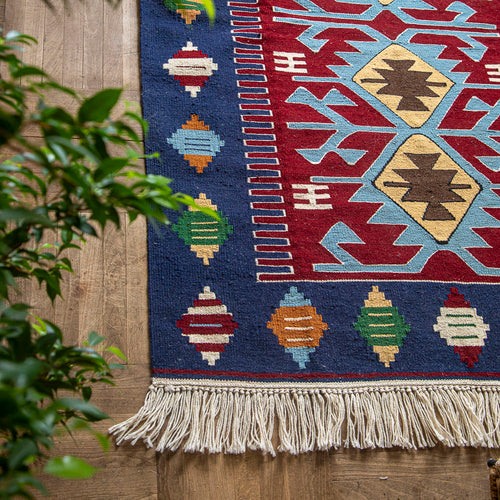
Neutral tones like ivory, gray, or beige work well for a modern, minimalist home. In a more colorful or unconventional setting, however, traditional kilim designs featuring bold reds, blues, and greens—or warm earth tones—are excellent choices.
Remember: your rug doesn’t have to match everything perfectly. Sometimes, a pop of contrasting color is exactly what breathes life into a room.
Hand-knotted rugs have a distinctive feel (even if it is hard to put into words).
Anyone who has ever compared a handmade kilim with a machine-made one will notice the difference—subtle, yet unmistakable.
It is not about perfection, but about variation. Small irregularities in the pattern or weave give the rug a more natural look within the room. It no longer resembles a mere printed surface; instead, it feels like a unique, handcrafted piece.
This is precisely what adds warmth to a room without being overpowering.
Care and maintenance for lasting beauty
Proper care ensures decades of enjoyment: vacuum weekly.
Rotate every 3–6 months to ensure even wear.
Blot up spills immediately (never rub).
Avoid excessive moisture and steam cleaning.
With minimal maintenance, wool kilim rugs retain their shape and color for years.
Final Thoughts
Choosing the right wool kilim doesn’t have to be complicated. Consider the room, select the right size, choose colors that match your style, and invest in high-quality craftsmanship.
A hand-woven wool kilim is more than just a decorative accessory—it adds warmth, character, and lasting beauty to your home. Whether in the living room, bedroom, hallway, or dining area, the right rug can make your space feel cozier, more inviting, and uniquely yours.
If you are looking for handcrafted pieces that combine tradition, durability, and timeless design, discover our carefully curated collections of natural wool kilims, created using authentic weaving techniques.
Find hand-woven wool kilims here:
https://balkanova.eco/de/collections/kelims